The Quantum Communication Revolution Hiding in Plain Sight
Picture this: you send a message that becomes fundamentally impossible to intercept without the sender and receiver knowing immediately. Not impossible because of clever encryption algorithms that might eventually be cracked, but impossible because the laws of physics themselves protect your communication. This isn’t science fiction anymore. Quantum entanglement communication systems are moving from laboratory curiosities to real-world applications, and they’re about to change everything we know about secure information transfer.
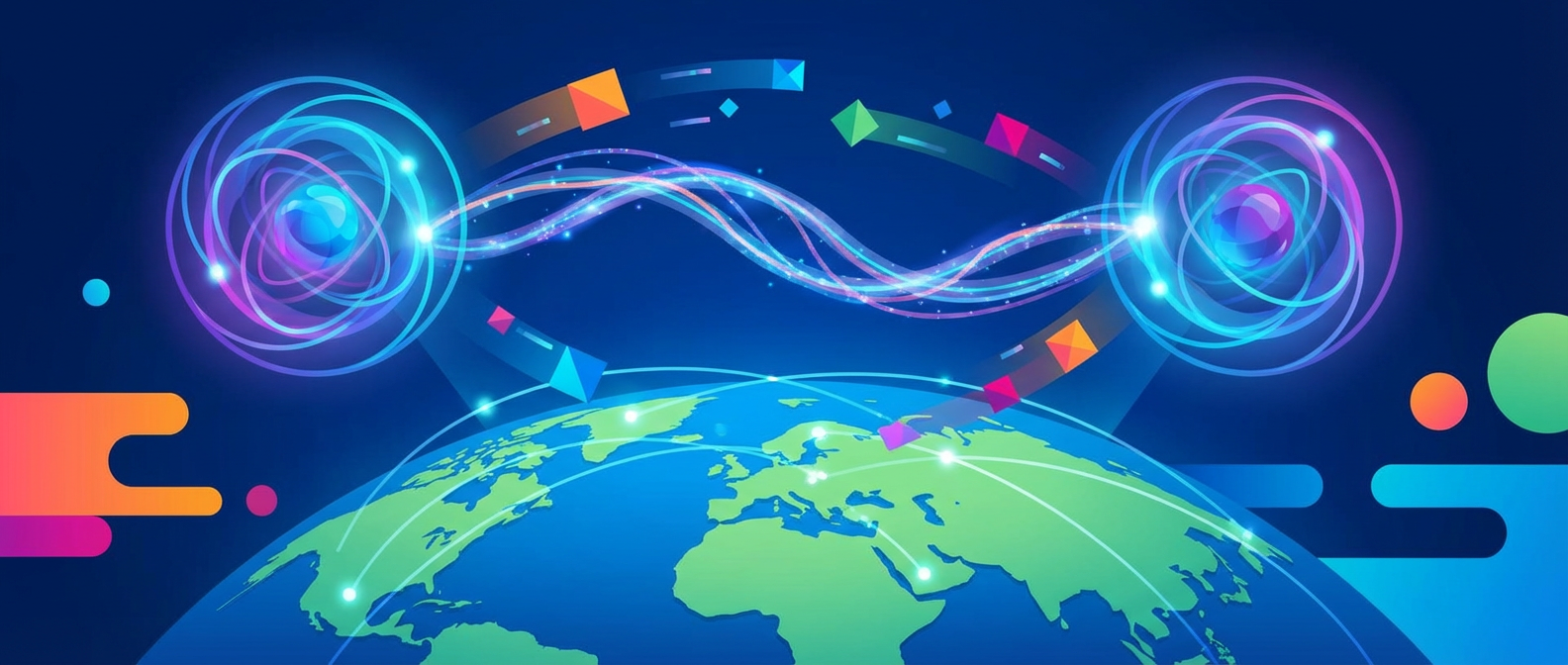
The urgency here isn’t just technological, it’s existential for our digital infrastructure. As quantum computers inch closer to breaking current encryption methods, we’re in a race between quantum threats and quantum solutions. The stakes couldn’t be higher. Every credit card transaction, every military communication, every piece of personal data flowing through our networks depends on mathematical encryption that quantum computers will eventually render obsolete. But quantum entanglement offers something unprecedented: security guaranteed by the fundamental nature of reality itself.
What makes this particularly interesting is that we’re not talking about theoretical physics anymore. Countries are already building quantum communication networks. China has deployed a 2,000-kilometer quantum communication line between Beijing and Shanghai. The European Union has invested billions in quantum internet infrastructure. The question isn’t whether this technology will emerge, it’s whether we’ll be ready when it does.
How Quantum Entanglement Actually Works for Communication
Let me break down the physics without losing the wonder. When two particles become quantum entangled, they form a connection that Einstein famously called “spooky action at a distance.” Measure one particle’s quantum state, and you instantly know the state of its entangled partner, regardless of the distance separating them. This isn’t just correlation, it’s something deeper. The particles exist in a shared quantum state until measurement collapses that state for both simultaneously.
Here’s where it gets practical for communication. In quantum key distribution (QKD), the most mature quantum communication technology, Alice and Bob (the classic names for communicating parties) share entangled photons. Alice measures her photons’ polarization states, creating a random sequence of quantum measurements. Because of entanglement, Bob’s photons carry the complementary information. They can use these correlated measurements to create identical cryptographic keys, strings of random numbers that unlock encrypted messages.
The security comes from quantum mechanics’ fundamental rules. If someone intercepts the entangled photons during transmission, they must measure them, which breaks the entanglement and introduces detectable errors. It’s like trying to read a letter in a dark room with a flashlight. The act of illumination reveals your presence. Alice and Bob can detect this interference by comparing small portions of their keys. If the error rate exceeds quantum mechanical predictions, they know someone was listening and can abort the communication.
Current systems achieve remarkable security over impressive distances. Researchers have demonstrated QKD over 400 kilometers of optical fiber and more than 1,400 kilometers via satellite links. The Chinese Micius quantum satellite has established secure quantum communication between ground stations separated by thousands of kilometers, proving that quantum entanglement can work on continental scales.
Beyond Security: The Broader Implications of Quantum Networks
Quantum communication extends far beyond secure messaging. Scientists are developing distributed quantum computing networks where entangled connections link quantum processors across vast distances. This could enable quantum computers to share quantum states directly, creating computational resources that go beyond the limitations of any single machine. Imagine quantum sensors scattered across a continent, all entangled and sharing information in ways that dramatically enhance their collective sensitivity.
The implications for scientific research are staggering. Quantum-enhanced sensor networks could detect gravitational waves with unprecedented precision, monitor environmental changes with quantum-level sensitivity, or track geological activity through coordinated quantum measurements. These applications use entanglement not just for security, but for fundamental improvements in measurement precision that classical networks cannot achieve.
Financial systems represent another compelling application. Beyond protecting transactions from conventional cyber threats, quantum networks could enable new forms of unforgeable quantum digital currencies. Trading systems could use quantum communication to ensure that market information reaches all participants simultaneously, eliminating advantages based on transmission delays that currently enable high-frequency trading arbitrage.
The Engineering Challenges We Must Solve
Real talk though. Significant obstacles remain before quantum communication becomes widespread. Quantum states are incredibly fragile. Environmental interference, temperature fluctuations, and electromagnetic noise can destroy entanglement faster than information can be transmitted. Current quantum communication requires specialized equipment including ultra-stable lasers, single-photon detectors, and precisely controlled optical systems that make implementation complex and expensive.
Distance limitations present another major challenge. Quantum information cannot be copied or amplified like classical signals, making long-distance transmission inherently difficult. While researchers have demonstrated quantum repeaters (devices that can extend quantum communication range by creating intermediate entangled links) these systems remain experimental and introduce their own technical complications.
Integration with existing infrastructure poses practical problems. Our current internet relies on routing, switching, and signal amplification that don’t translate directly to quantum systems. Building hybrid networks that can handle both quantum and classical information requires developing new protocols, hardware interfaces, and network management systems. The transition period will be particularly challenging as organizations must maintain classical systems while gradually incorporating quantum capabilities.
The Timeline for Quantum Communication Adoption
The deployment timeline varies dramatically depending on application and scale. Point-to-point quantum key distribution for high-security applications is already commercially available, with companies like ID Quantique and Toshiba offering operational systems. Financial institutions, government agencies, and research organizations are beginning to integrate QKD into their security infrastructure for protecting the most sensitive communications.
Metropolitan-scale quantum networks should emerge within the next decade. Several cities are already testing quantum communication infrastructures, and the technology for urban-scale deployment is approaching commercial viability. These networks will initially handle specialized applications requiring maximum security, gradually expanding as costs decrease and reliability improves.
Global quantum internet remains further out, probably fifteen to twenty years before widespread deployment. The technical challenges of maintaining entanglement over intercontinental distances, developing efficient quantum repeaters, and creating standardized protocols require substantial additional research. However, satellite-based quantum communication could accelerate this timeline by bypassing terrestrial distance limitations.
What makes this particularly urgent is the parallel development of quantum computers capable of breaking current encryption. Experts estimate that cryptographically relevant quantum computers could emerge within the next fifteen years, creating a potential security gap if quantum communication infrastructure isn’t ready. This race between quantum threats and quantum solutions will likely drive accelerated investment and development over the coming decade.
The revolution in quantum communication isn’t just coming, it’s already begun in laboratories and early deployment sites around the world. Whether you’re fascinated by the fundamental physics or worried about practical security implications, now is the time to understand and engage with this technology that will reshape how we think about information, privacy, and the very nature of communication itself.