The Current State of Quantum Entanglement Communication
When you read headlines about quantum entanglement enabling “instantaneous communication across any distance,” your first instinct should be healthy skepticism. While quantum entanglement is undeniably real and thoroughly validated through decades of experiments, the path from laboratory demonstration to practical communication systems involves engineering challenges that most popular coverage glosses over entirely.
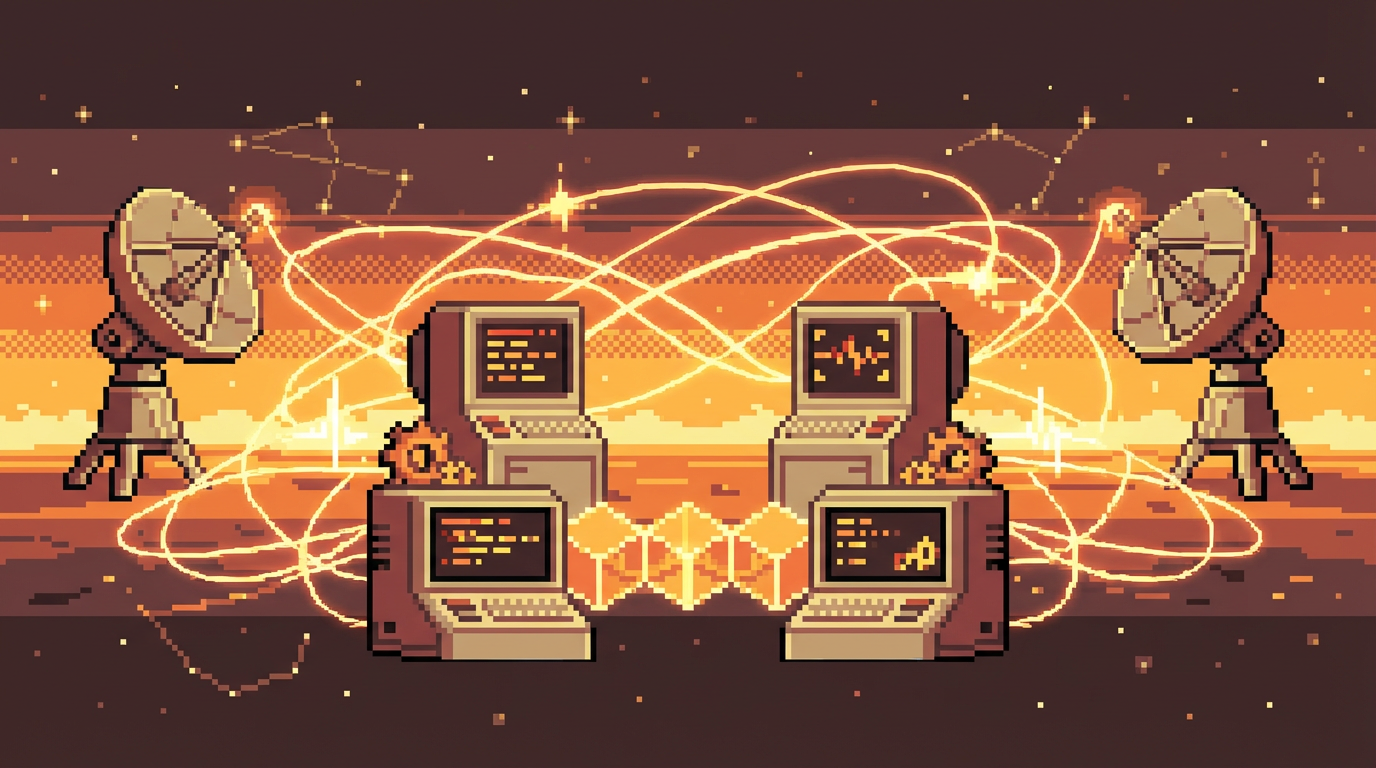
What we actually have today are quantum key distribution networks spanning hundreds of kilometers, like the Beijing-Shanghai quantum communication backbone that stretches over 2,000 kilometers using trusted repeater nodes. These systems don’t transmit information faster than light. Instead, they use entangled photons to establish cryptographic keys with security guaranteed by the fundamental laws of physics rather than computational complexity. The distinction matters enormously because it separates genuine near-term applications from speculative long-term possibilities.
Current quantum communication protocols require classical communication channels to complete the information transfer process. When Alice and Bob share entangled particles and Alice performs a measurement, Bob’s particle instantly assumes a correlated state. But Bob cannot determine what Alice measured without classical communication traveling at light speed or slower. This fundamental limitation, often called the “no-communication theorem,” means that science fiction-style instantaneous messaging remains physically impossible even with perfect quantum technology.

Engineering Bottlenecks That Define the Realistic Timeline
The photons used in quantum communication systems face a brutal reality: they get absorbed by optical fibers at predictable rates. Even the best telecommunications fiber absorbs roughly half the photons every 20 kilometers. This exponential decay means that direct quantum communication over continental distances requires solving either the photon loss problem or the quantum repeater problem. Both involve technologies that barely exist in laboratory settings today.
Quantum repeaters represent the most promising solution, but they require quantum memories capable of storing entanglement for the time it takes classical signals to coordinate the network. Current quantum memory systems can preserve entanglement for milliseconds in laboratory conditions. Practical continental networks would need memory systems maintaining entanglement for seconds or minutes while operating in real-world environments with temperature fluctuations, electromagnetic interference, and mechanical vibrations. The gap between laboratory demonstrations and field-deployable systems spans multiple orders of magnitude in performance requirements.
Satellite-based quantum communication offers an alternative approach that bypasses fiber optic losses by transmitting through the vacuum of space and thin upper atmosphere. China’s Micius satellite has demonstrated entanglement distribution across thousands of kilometers, but these systems currently operate at extremely low data rates and require perfect weather conditions. Scaling to commercial viability demands advances in satellite constellation design, ground station technology, and atmospheric compensation systems that extend well beyond current capabilities.
The error rates in quantum communication systems present another fundamental challenge. While classical digital communication can achieve arbitrarily low error rates through error correction codes, quantum information cannot be copied or amplified without destroying the quantum properties that provide security advantages. Quantum error correction exists in theory and small-scale laboratory demonstrations, but practical implementation requires hundreds or thousands of physical qubits to protect each logical qubit of information. This overhead makes quantum error correction prohibitively expensive for communication applications in the foreseeable future.
How This Might Reshape Technology and Society
If quantum communication networks achieve technical maturity over the next two decades, the ripple effects could reshape entire industries in ways that extend far beyond simple secure communication. Financial markets rely on split-second timing advantages measured in microseconds, but quantum networks could enable trading strategies based on unhackable information distribution with timing guarantees that classical networks cannot provide. High-frequency trading algorithms might evolve to exploit quantum communication advantages, potentially creating new forms of market inequality between institutions with quantum network access and those without.
The cybersecurity implications extend beyond protecting individual communications to safeguarding the classical internet infrastructure itself. Quantum computers threaten current public-key cryptography systems that secure everything from banking transactions to software updates. Quantum communication networks could provide a migration path for critical infrastructure, but the deployment timeline creates a vulnerable transition period where some systems have quantum-safe security while others remain exposed to quantum computing attacks. Managing this transition requires coordinated international standards and massive infrastructure investments that governments and corporations are only beginning to plan.
Scientific research could experience unexpected acceleration if quantum communication enables new forms of distributed sensing and measurement networks. Quantum sensor arrays linked by entanglement could achieve measurement precision that surpasses classical sensors by orders of magnitude. Gravitational wave detectors, dark matter searches, and precision tests of fundamental physics might benefit from quantum networking in ways that are difficult to predict from our current perspective. These applications could emerge decades before consumer quantum communication becomes practical.
Separating Hype from Genuine Breakthrough Potential
The most important skill for following quantum communication research is learning to distinguish between incremental improvements in existing laboratory demonstrations and genuine breakthroughs that change the engineering constraints. When research papers report new distance records for quantum entanglement distribution, pay attention to the trade-offs in data rate, error rate, and operating conditions. A system that works perfectly in a temperature-controlled laboratory with vibration isolation might fail completely when deployed in real-world conditions.
Watch for developments in quantum repeater architectures and quantum memory systems rather than focusing solely on distance records. The fundamental physics of quantum entanglement is well-established, but the engineering challenge lies in building reliable quantum information processing systems that operate outside laboratory conditions. Advances in quantum computing hardware often translate directly to quantum communication capabilities, since both applications require similar levels of quantum state control and error management.
Corporate announcements about quantum communication partnerships and pilot programs should be evaluated based on specific technical milestones rather than broad strategic statements. Companies that provide detailed specifications for data rates, error rates, operating distances, and environmental requirements are more likely pursuing genuine engineering solutions rather than marketing-driven research programs. The distinction matters for investors, policymakers, and scientists trying to plan for realistic deployment timelines.
The Long View: What Quantum Communication Might Enable
Looking beyond current technical limitations, mature quantum communication networks could enable distributed quantum computing architectures that surpass any single quantum computer. By linking quantum processors through entanglement, researchers might solve computational problems that require more qubits than any individual machine could provide. This capability could accelerate drug discovery, materials science, and artificial intelligence research in ways that compound across multiple fields simultaneously.
The ultimate potential lies in quantum internet protocols that treat quantum entanglement as a network resource similar to how the classical internet treats bandwidth and routing capacity. Such networks might support applications we cannot currently imagine, just as the early internet enabled social media, streaming video, and cloud computing applications that were inconceivable to the original network designers. The key insight is that transformative applications often emerge from the intersection of mature infrastructure capabilities rather than from any single breakthrough technology.
If you find these possibilities as fascinating as I do, the best way to track genuine progress is to follow the research groups publishing reproducible results with detailed technical specifications. The quantum communication field moves quickly, and the gap between laboratory demonstrations and practical applications continues to narrow as engineering challenges receive the same rigorous attention that theoretical physics has enjoyed for decades.