The February 2025 Announcement That Made Quantum Researchers Actually Pause
In February 2025, Microsoft announced something that made me reread the press release three times because I kept expecting to find the catch. They unveiled Majorana 1, a quantum processor built on what they’re calling a topological core architecture using topoconductor materials. This isn’t just another incremental improvement in qubit count or coherence time. This is Microsoft stepping back from the superconducting qubit race that’s consumed IBM and Google for the past decade and saying: we think you’ve all been approaching this wrong.
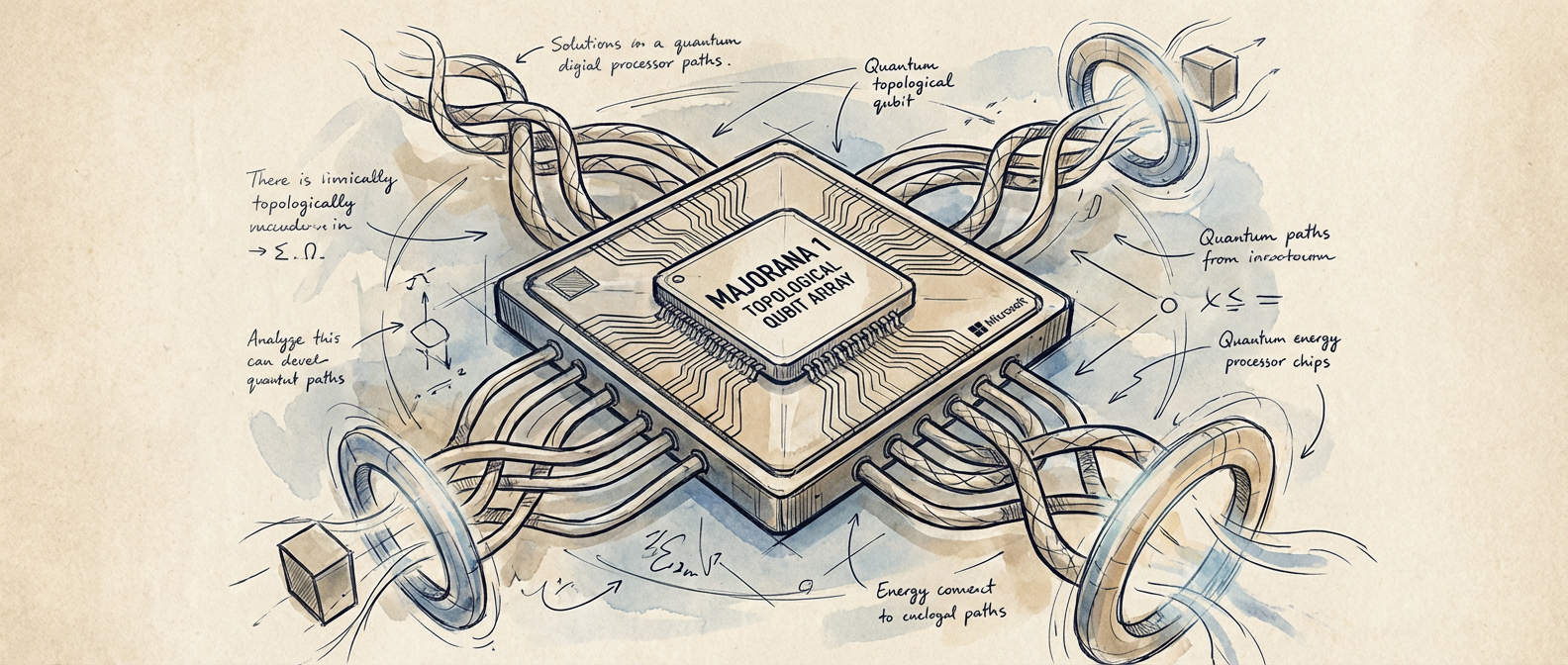
Here’s what makes this different. Instead of fighting the physics of superconducting qubits, Microsoft built their processor around Majorana fermions, exotic quasiparticles that exist in specially engineered materials at temperatures hovering just above absolute zero. The claim isn’t subtle: these topological qubits are inherently more stable than the superconducting alternatives, potentially reducing error correction overhead by multiple orders of magnitude. That’s not marketing speak. That’s the kind of statement that either represents a genuine architectural advantage or becomes a very expensive footnote in quantum computing history.

Why Topological Qubits Matter More Than You Might Think
To understand why Microsoft is making this bet, you need to understand the error correction problem that keeps quantum researchers awake at night. Superconducting qubits are temperamental. They’re sensitive to electromagnetic noise, thermal fluctuations, and magnetic field variations. IBM and Google have both poured enormous resources into error correction schemes that essentially require multiple physical qubits to encode a single logical qubit, ratios that can climb above 1000 to 1 in some architectures. IBM’s roadmap, which targets 100,000 qubit systems by 2033, reflects this brutal reality: you need sheer quantity to compensate for the error rates inherent to the technology.
The topological approach works differently. Majorana fermions exhibit what physicists call topological protection, meaning their quantum information is encoded in a way that’s inherently resistant to local perturbations. In simpler terms: the information isn’t as easy to accidentally destroy. The indium arsenide-aluminum heterostructure described in the accompanying Nature paper creates conditions where these Majorana fermions can exist in quasi-stable states. At temperatures near absolute zero, this architecture enables qubits that maintain coherence longer and require fewer error correction redundancies.
Microsoft’s strategy is fundamentally different from their competitors. Rather than racing toward 100,000 qubits through brute force, they’re aiming for equivalent computational power at dramatically lower physical qubit counts. If the error correction mathematics work out the way they’re claiming, you might achieve the same effective quantum computing power with thousands of qubits instead of hundreds of thousands. That’s not just an engineering improvement. That’s a different category of advantage.
The Google Problem: Quantum Supremacy Versus Practical Utility
I need to address the elephant in the room, which is Google’s Willow chip, announced in December 2024. Google demonstrated what appears to be genuine quantum supremacy: their chip solved a specific benchmark problem in under five minutes that would require a classical supercomputer approximately 10 septillion years to solve. That’s not a typo. That’s genuinely quantum advantage on a measurable task.
But here’s what matters: quantum supremacy on a specialized benchmark and quantum utility for real-world problems are two different mountains to climb. Google’s achievement is scientifically significant and represents real progress. It shows that quantum processors can do things classical computers literally cannot do. The Willow results also demonstrate that Google’s team has solved some profound challenges in superconducting qubit coherence and error correction.
What Willow doesn’t demonstrate is whether this approach scales to the thousands or millions of qubits we’d need for applications like drug discovery, materials science, or optimization problems that actually matter economically. The topological qubit approach sidesteps this scaling problem by design. You need fundamentally fewer qubits to reach the same computational power. Whether that theoretical advantage translates to practical reality is the question that will define the next three to five years of quantum computing research.
The Technical Credibility Check: What the Nature Paper Actually Says
The peer review process matters here. Microsoft didn’t just make claims in a press release; they published the technical architecture in Nature, one of the most rigorous journals in science. The Nature paper detailing the topological qubit architecture describes the precise heterostructure engineering and measurement protocols that enable the topoconducting behavior. This isn’t consensus yet, one paper rarely is, but it’s credible enough that the broader physics community is taking it seriously rather than dismissing it out of hand.
The specific technical details matter. The indium arsenide-aluminum heterostructure creates a one-dimensional topological superconductor at the interface. When the system is cooled and exposed to the right magnetic field, Majorana fermions appear at the ends of the wire. These aren’t just theoretical constructs; they’re measurable quasiparticles. The Nature paper provides evidence for their presence and characterizes their behavior in ways that independent researchers can potentially reproduce and verify.
Does this mean Microsoft has solved quantum computing? No. Not even close. What it means is that they’ve demonstrated a pathway that, if the physics continues to cooperate, could offer genuine advantages over the approaches their competitors are pursuing. The paper is substantial enough that we should take the claims seriously while staying appropriately skeptical about scaling and long-term stability.
What Happens Next: The Credibility Test
The next few years will determine whether Majorana 1 represents a genuine breakthrough or an interesting detour. Microsoft needs to demonstrate that topological qubits maintain their promised stability as they scale the system. They need to show that error rates actually improve the way the theory predicts. They need to solve practical engineering challenges around maintaining the precise heterostructure properties and operating conditions across many qubits simultaneously.
Meanwhile, IBM and Google won’t be standing still. Google’s path forward involves perfecting error correction on superconducting qubits and pushing toward practical applications. IBM’s strategy focuses on scaling through incremental improvements and industry partnerships. Both approaches have momentum and institutional backing. Microsoft is essentially betting that a different fundamental architecture will ultimately prove superior.
Here’s what I find genuinely exciting about this moment: we have three different approaches from three well-funded organizations, each backed by serious physics and engineering teams, each claiming credible pathways to practical quantum computing. This is how scientific progress actually works. Not one brilliant insight dominating the field, but multiple teams pursuing different strategies, sharing results through peer review, and letting the evidence eventually reveal which approach scales most effectively.
The honest truth is that I don’t know if Microsoft’s topological approach will prove superior to superconducting qubits. Neither does anyone else right now. What I do know is that the Microsoft Majorana 1 announcement represents a serious technical contribution to an open question. The physics is plausible. The engineering is ambitious. The stakes are real.
What do you think? Are you more convinced by Microsoft’s topological gamble, Google’s demonstration of quantum supremacy, or IBM’s incremental scaling strategy? Drop your thoughts in the comments. I’ll be reading research papers late into tonight trying to understand the implications better, and I’d love to know what’s captured your attention in the quantum computing landscape.