The Carbon Vault Beneath Our Feet
There is a moment in the early morning hours, usually around 2 AM, when you realize the ground itself has become a time bomb. Not in the theatrical sense that headlines sometimes suggest, but in the way that makes you sit back and understand how profound climate disruption actually is. A 2025 supplementary report from the IPCC focusing on cryosphere dynamics has crystallized something climate scientists have understood for years but struggled to communicate: the Arctic permafrost contains roughly 1.5 trillion metric tons of organic carbon locked in frozen soil. That figure represents approximately double the amount of carbon currently suspended in Earth’s entire atmosphere right now. Let that settle for a moment.
The implications are staggering without being immediately apocalyptic, which is precisely what makes them worth serious attention. We are not talking about a doomsday device waiting for a single trigger. We are looking at a geological storage system that has held this carbon stable for thousands of years, now entering an era of profound instability. The IPCC Cryosphere Special Report represents months of rigorous assessment by hundreds of researchers examining satellite data, ground measurements, and paleoclimate reconstructions. Their conclusion is careful: the permafrost carbon cycle is accelerating, but the worst-case scenarios remain avoidable through sustained climate action.
When Siberia Became a Warning Signal
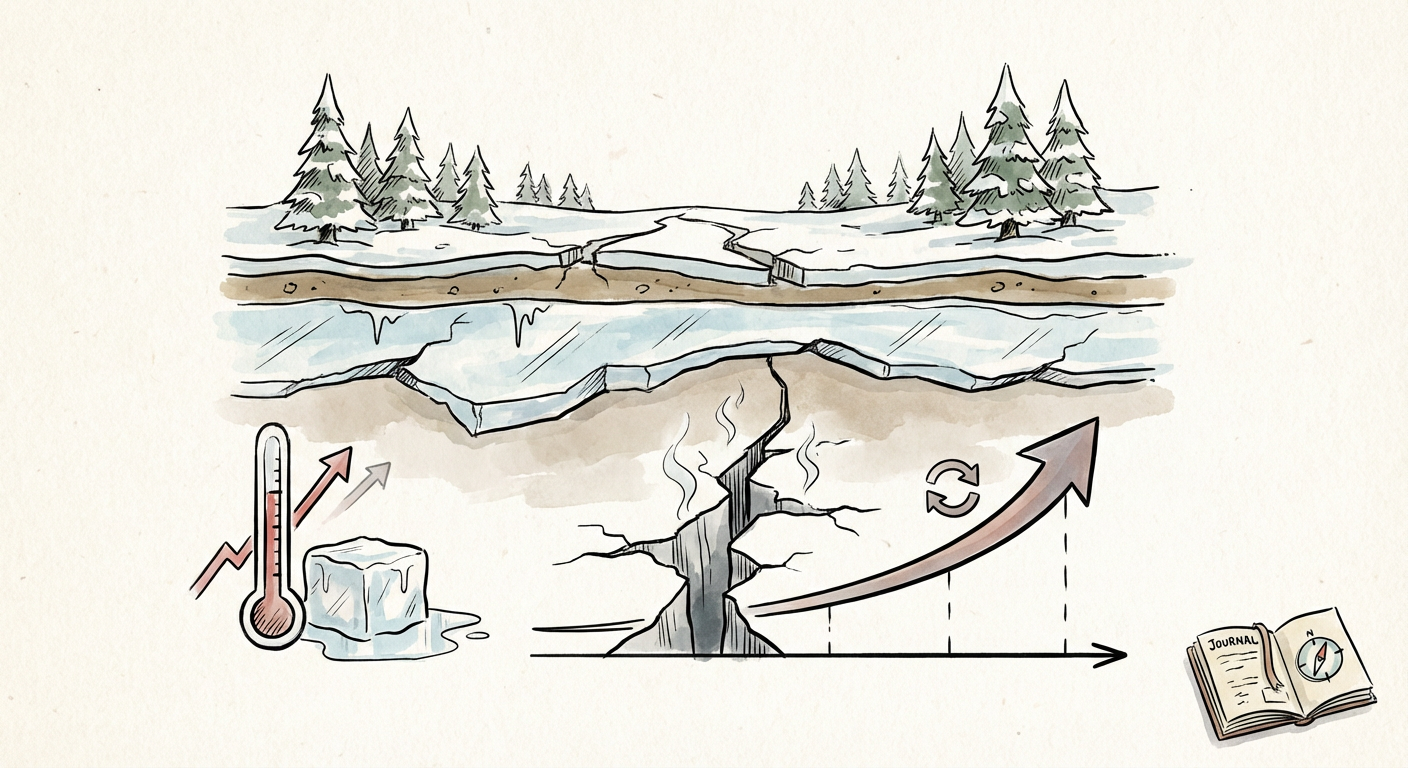
Permafrost is not distributed evenly across the Arctic. Siberia has become the focal point of intensive monitoring because it contains the largest reserves of frozen organic matter and because it is warming faster than almost anywhere else on the planet. Between 1990 and 2024, according to data from the Global Terrestrial Network for Permafrost, Siberian permafrost temperatures rose by an average of 2.3 degrees Celsius. That might sound modest until you look at when the warming hit hardest. The fastest increases came after 2018, climbing at rates that surprised even researchers who had been expecting significant changes.
What strikes me when I read through these datasets is the human element embedded in the numbers. Scientists have been installing thermometers in holes drilled deep into permafrost for decades, visiting the same monitoring stations year after year in one of Earth’s harshest environments. They have watched the readings climb. They have seen active layer depths increase, watched the uppermost layer of permafrost that thaws seasonally expand year after year. This is not theoretical modeling. This is direct observation of a system in transition, recorded with methodical precision across multiple continents and research institutions.
The Inconvenient Middle Ground
Here is where the scientific reality gets more complicated than the headlines usually allow. A comprehensive 2025 study published in Nature Climate Change used satellite-based methane sensors to measure how much carbon dioxide equivalent is currently being released from permafrost thaw. The findings suggest permafrost emissions are contributing approximately 0.3 gigatons of CO2-equivalent annually. That is substantial, not trivial. But it is also lower than what the worst-case climate models predicted for this time period. Current emissions from permafrost thaw represent roughly one percent of global greenhouse gas emissions from all sources combined.
The crucial caveat is that this figure is accelerating. We are not looking at a steady-state problem but a system that is gradually releasing more carbon as temperatures climb. The satellite data shows clear acceleration trends over the past decade. This is why researchers keep emphasizing the difference between current risk levels and future trajectory. We are not yet in a runaway scenario, but we are moving toward one at an increasing pace. The question becomes not whether permafrost carbon will become a major climate forcing, but how quickly we can stabilize global temperatures before that transition becomes inevitable.
Ancient Carbon, Modern Consequences
One of the most unsettling discoveries of recent permafrost research involves the Yedoma deposits scattered across northeastern Siberia and parts of Alaska. These are ice-rich soil formations that extend up to 50 meters deep, packed with organic material frozen for more than 10,000 years. When Yedoma thaws, it releases carbon that accumulated during the Pleistocene epoch, carbon isolated from Earth’s modern carbon cycle for millennia. This is not simply recent vegetation being decomposed. This is ancient peat, ancient plant material, ancient methane stored in permafrost since before human civilization.
The thaw process is brutal in its efficiency. As ground temperatures rise, the ice binding these soils together melts. The soil collapses. Microbes, dormant for thousands of years, suddenly encounter unfrozen organic matter and begin their metabolic work. The decomposition releases both carbon dioxide and methane. In some cases, particularly in areas with poor drainage, methane production dominates. Methane is approximately 28 to 34 times more potent than carbon dioxide over a century-long timescale. The visual consequence is striking: satellite imagery shows the Siberian landscape literally sinking and fracturing as Yedoma permafrost destabilizes. It is one of the most visible examples of how climate change is reshaping Earth’s surface geography.
Tipping Points and the Threshold Question
The Stockholm Resilience Centre published a significant analysis in 2025 identifying permafrost thaw as one of six Earth system tipping points with the potential for self-perpetuation. Their research suggests that beyond 1.5 degrees Celsius of global warming, permafrost thaw could become self-sustaining, continuing to release carbon even if human emissions were somehow cut to zero. This is the tipping point concept that rightfully concerns climate scientists. It is not about today’s permafrost emissions causing immediate catastrophe. It is about the possibility of triggering a feedback loop that becomes genuinely independent of human control.
The Stockholm research, available through their Stockholm Resilience Centre Tipping Points Research, is a deliberately sobering assessment. But here is what I find worth noting: they identify permafrost as one of six tipping points, not the only one or even the most immediate one. The Greenland ice sheet and the Atlantic Meridional Overturning Circulation may be closer to critical thresholds than Arctic permafrost. This does not minimize permafrost risk. It places it within a broader picture of climate system vulnerabilities that we have to address simultaneously, which is its own kind of overwhelming.
What Scientists Actually Disagree About
The most honest assessment of the 2025 permafrost research involves acknowledging the genuine uncertainties that persist among climate scientists. There is broad consensus that permafrost thaw is accelerating and will become a larger component of global carbon emissions. There is less certainty about the exact magnitude of potential feedback loops, the timing of potential tipping point activation, and regional variability in thaw rates across different Arctic systems. Some research suggests methane hydrate destabilization in permafrost may be self-limiting in certain regions due to soil chemistry. Other research suggests the opposite. This is not weakness in climate science. It is the normal process of scientific refinement.
What unites researchers across these disagreements is a common conviction that permafrost dynamics cannot be ignored in climate policy. Most permafrost specialists argue that limiting global warming to 1.5 degrees Celsius would substantially reduce permafrost thaw. Limiting it to 2 degrees would slow but not halt acceleration. Uncontrolled warming would eventually trigger the feedback mechanisms that make permafrost a truly serious climate risk factor. This is not a methane bomb waiting for detonation. It is a manageable risk that becomes increasingly unmanageable with every tenth of a degree of warming we allow.