The Race Nobody Expected to Lose
Let me tell you about the experiment that didn’t go the way everyone predicted. Neuralink, the company that had captured the collective imagination of neuroscience enthusiasts everywhere, finally achieved what seemed inevitable: a human patient controlling a computer cursor with their thoughts. The headlines screamed triumph. The videos showed a paralyzed individual playing video games and moving a digital pointer with remarkable fluidity. By any reasonable measure, this was a breakthrough moment in 2024. But here’s the part that keeps me awake at night, the part that reveals something fundamental about how science actually progresses: Synchron had beaten them to it by eighteen months. Not with flashier technology, not with a more invasive array of electrodes, but with a stent-based design that threaded through blood vessels instead of requiring open brain surgery. While everyone was watching one company, another was quietly solving a problem nobody had fully appreciated: how to minimize the trauma of implantation itself.
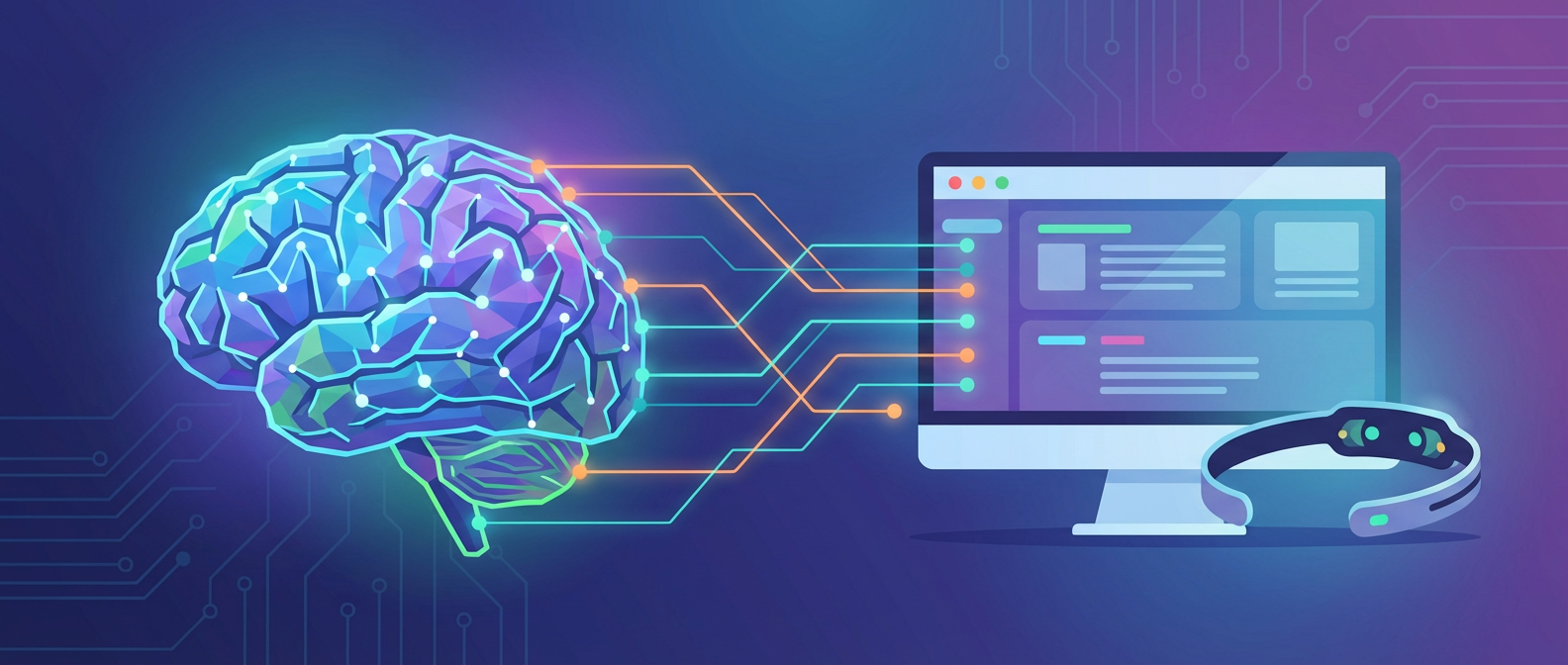
This is the nature of scientific advancement that rarely makes it into the celebratory coverage. We focus on victories, on the moment of breakthrough, but we gloss over the false starts, the dead ends, and yes, the companies that got there first but somehow weren’t part of the narrative. The interesting question isn’t why Neuralink succeeded with brain-computer interfaces. The interesting question is why the success story became about the most invasive approach when a less traumatic alternative had already been validated in human patients. That tension reveals everything about how we evaluate progress in neurotechnology.
When Non-Invasive Meets the Limits of Physics
There’s something seductive about the idea of brain-computer interfaces that don’t require surgery. No risk of infection. No craniotomy. No permanent implant sitting in your neural tissue for the rest of your life. The consumer appeal is obvious, which is why commercial non-invasive BCI headsets have proliferated, with products reaching 32 channels of electrode coverage designed for gaming and consumer applications. I’ve read the user reviews. I’ve seen the marketing materials. They’re legitimately impressive from an engineering standpoint. They measure electrical activity across the scalp with surprising sophistication.
But here’s where intellectual honesty gets uncomfortable: they don’t actually work as well as invasive systems, and the physics explains why. Your skull is an excellent insulator. The cerebrospinal fluid is conductive but imperfect. The signal degrades. The spatial resolution collapses. A 32-channel headset gives you broad information about what large populations of neurons are doing. An implanted electrode array gives you information about what individual neurons are doing. That’s not a matter of opinion or marketing spin. That’s signal-to-noise ratio, and no amount of clever signal processing can fully overcome that fundamental constraint. So we have a genuine dilemma: non-invasive systems are safer but less precise, while invasive systems are powerful but carry surgical risks. Both approaches are actively advancing, and it’s entirely possible we’re going to need both for different applications.
The Speech Decoder Problem That Refused to Stay Solved
One of the most tantalizing recent advances involves decoding speech from neural activity. Paralyzed patients with implanted electrodes are now able to communicate through systems that translate their neural signals into text, achieving speeds around 80 words per minute. Stop and think about that number for a moment. That’s not just faster than typing with eye trackers. That’s approaching natural conversation speeds. The research papers coming out of teams working on this problem read like detective stories, with each year bringing new techniques for identifying which neurons are involved in speech planning versus execution. Nature Neuroscience journal has published some remarkable work in this space, and I’ve gone down some genuinely deep research rabbit holes trying to understand the signal processing methods involved.
But here’s what doesn’t make the headlines: the individual variation is staggering. What works beautifully for one patient might fail for another. The neural code for speech appears to have personal dialects, quirks that differ from brain to brain. Some patients produce clean, consistent signals. Others have noisier patterns that resist decoding. Some electrode placements capture the relevant neural populations. Others miss them by millimeters. This isn’t exactly a failure of the technology. It’s a reminder that neural interfaces are deeply biological, deeply individual. The same approach won’t scale perfectly. We’re going to need customization, adaptation, personalization at every step. That’s not a problem to be embarrassed about. That’s the actual frontier we’re working on.
Memory Prosthetics and the Regulatory Fog
Recent memory prosthetics trials in human patients have shown something genuinely remarkable: a 30 percent improvement in recall performance for stimulation protocols delivered to the medial temporal lobe. Thirty percent. In a world where most cognitive interventions show single-digit improvements, that’s substantial. The experimental logic is sound. If you can record neural patterns associated with successful memory encoding, and replay those patterns during learning, you effectively enhance memory formation. It’s elegant, and it’s moving from animals to humans, which is always the critical step where theoretical promise confronts biological reality. Some of it works. Some of it doesn’t. Some of it works for people with certain types of memory impairment but not others. We’re learning to parse those differences.
And then we hit the regulatory problem that somehow doesn’t get discussed enough. These devices exist in a strange limbo. The FDA has pathways for neural recording devices and for therapeutic stimulators, but the regulatory framework for integrated brain-computer interfaces that both record and stimulate remains genuinely unclear. The European Union’s Medical Device Regulation creates different classification requirements than the American approach. IEEE Spectrum brain-computer interfaces coverage has highlighted this issue repeatedly, but it’s not sexy. Nobody’s writing fiction about regulatory harmonization meetings. Yet this bureaucratic fog is actively slowing research and delaying devices that could help people. That’s not a failure of the technology. That’s a failure of governance to keep pace with innovation.
Why Failed Experiments Deserve Respect
The thing that strikes me most forcefully, reading through the literature and preprints late at night, is how much of transformative neuroscience comes from people willing to work on problems that mostly don’t work, problems that generate more negative results than positive ones. The experiments that fail teach you about the boundaries of what’s possible. They tell you where your assumptions were wrong. They reveal the gap between what you thought was true and what actually is true, which is the fundamental work of science.
Neuralink didn’t fail. Synchron didn’t fail. The companies and researchers pursuing non-invasive approaches didn’t fail. Everyone is succeeding in different ways, solving different problems, hitting different limitations. That’s not a narrative that fits neatly into headlines, but it’s the actual story of how this technology is advancing. We’re building multiple approaches because the problem is harder than any single solution can address. We’re dealing with the surgical challenges of implantation, the signal degradation of non-invasive recording, the individual variability of neural codes, and the regulatory uncertainty of an entirely new category of medical device. That’s not a list of problems. That’s an accurate description of where the frontier actually is.
If you’re tracking this field, the real story isn’t about which company wins. It’s about which approaches solve which problems, and how we learn to combine them into systems that actually work for actual people living actual lives. That’s messier, less certain, and infinitely more interesting. What aspects of brain-computer interfaces are keeping you awake at night? I’d genuinely like to know what questions are pulling you deeper into this space.